2D frames · steel and timber
XFrame2D: 2D frames and trusses in steel and timber
Portals, halls, trusses and roof frames in the plane. With the Eurocode checks on, the analysis is second-order with imperfections, and every member check is written out with its clause.
EN1990–1995NANL · BE · UK · DE · IT
Free download · first hour free · €100 welcome credit when you register · then pay per use · no credit card · Windows
The jobs it does
What engineers use it for, day to day.
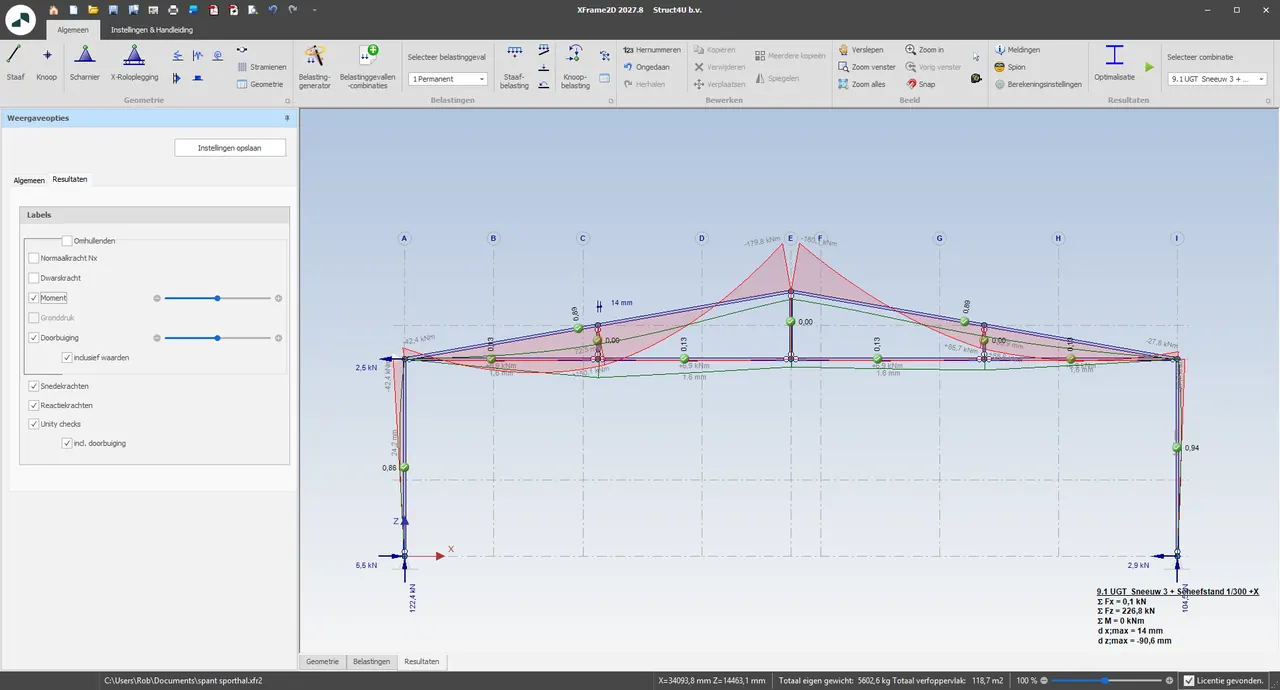
Portals and halls
The load generator reads flat, mono-pitch and duo-pitch roofs and generates wind, snow and all load combinations to EN 1991.
In the manualTrusses
Steel and timber trusses, analysed second-order, with every member checked per clause.
Timber roof frames
Rafters, collar beams and knee walls to EN 1995-1-1, with the load-duration class in each check.
Moment joints
Bolted and welded beam-to-column joints to EN 1993-1-8, with their rotational stiffness in the frame analysis.
In the manual
With the checks on, the analysis is always second-order (manual: Calculation settings).
What it does, tab by tab
Model
- Nodes, beams and supports in any combination: springs, local axes, and supports that come free under tension.
- Steel, timber and built-up profiles; user-defined materials.
- Beam loads, node loads and prescribed displacements, in load cases and combinations.
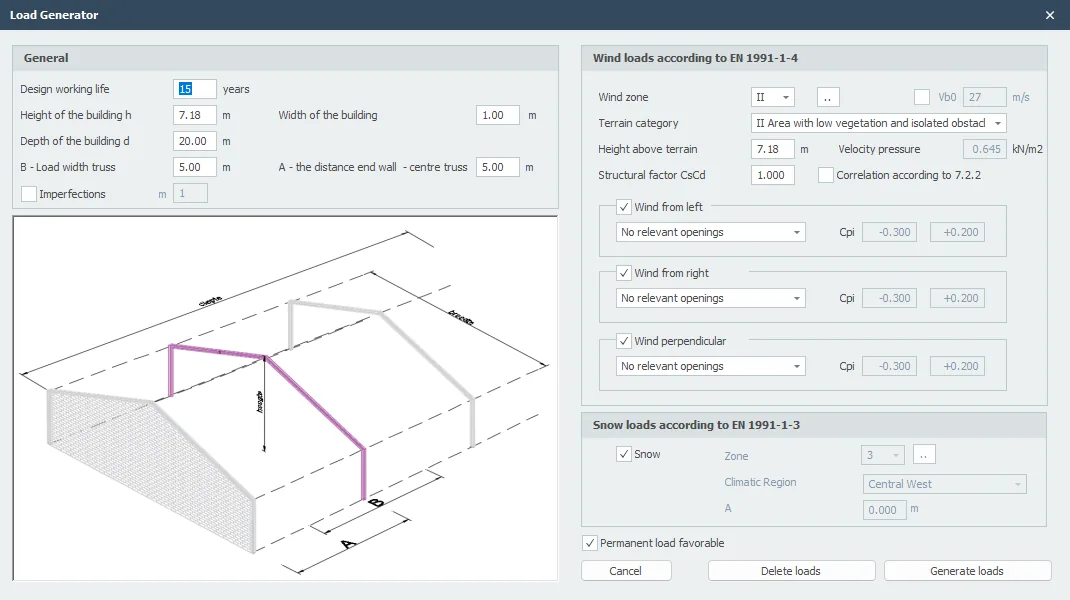
- A load generator for wind (EN 1991-1-4) and snow (EN 1991-1-3) on flat, mono-pitch and duo-pitch roofs.
- Beams on an elastic foundation, with compression-only springs solved in the load combinations.
- Build models from Excel with DirectCommands or with XSpreadsheets.
Analysis
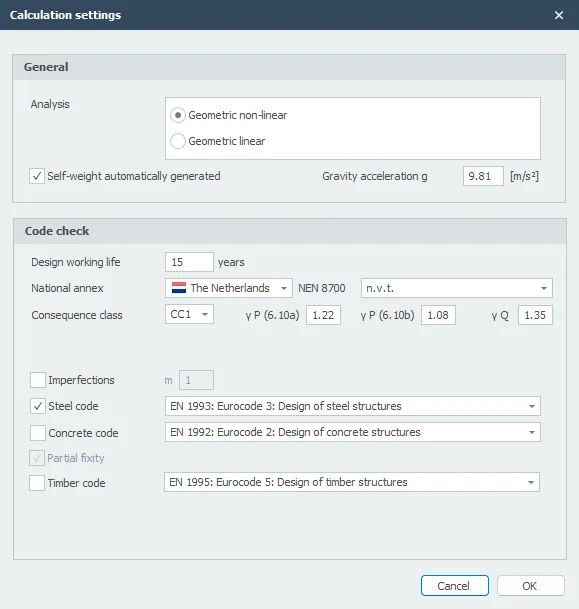
- First order (GL) or geometrically non-linear (GNL). With the Eurocode checks on, the analysis is always GNL.
- A global tilt imperfection, in two directions. Member imperfections are covered in the check, with the buckling length equal to the member length.
- A new solver since version 2027.3, which cuts the calculation time, above all on large models.
- Fire resistance of steel structures, since version 2027.6.
Design checks
- Steel members to EN 1993-1-1, lateral-torsional buckling included (kc after Serna et al.), with a profile optimiser.
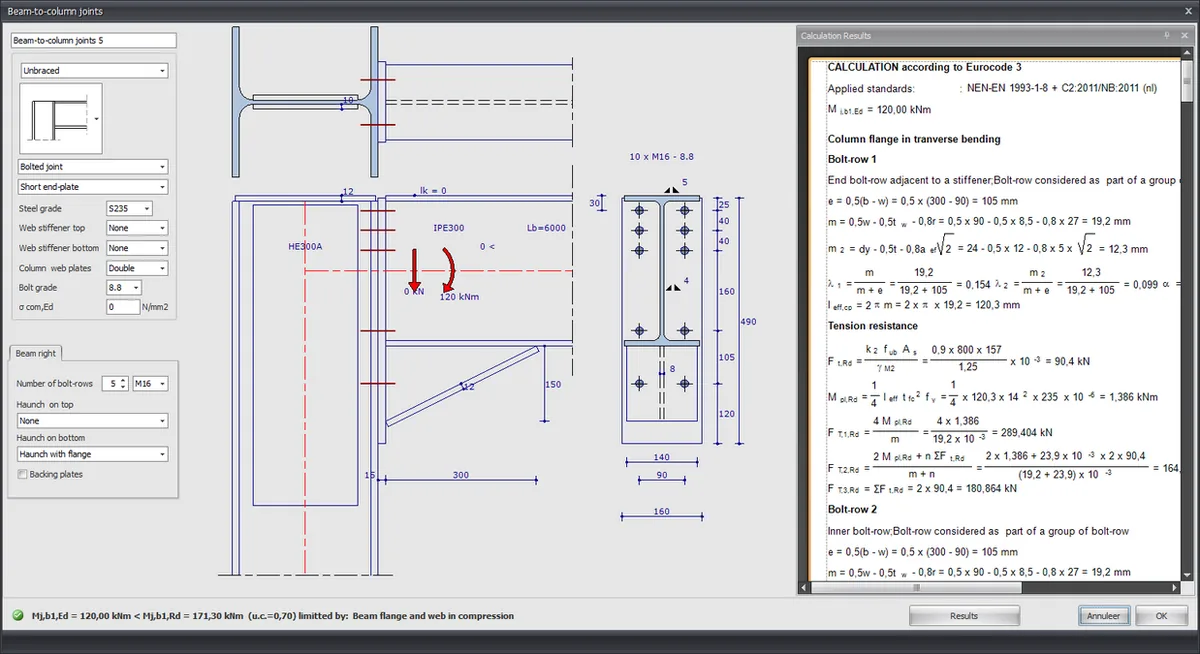
- Beam-to-column joints to EN 1993-1-8, bolted or welded: moment resistance, stiffness and classification.
- Timber members to EN 1995-1-1.
- Fire resistance of steel members.
- NEN 8700 partial factors for existing structures (Netherlands).
Codes and annexes
Eurocodes for loads, steel and timber, with five national annexes.
| Code · Used for | NL | BE | UK | DE | IT | ES | PT |
|---|---|---|---|---|---|---|---|
| EN 1990Basis of design, load combinations | Netherlands: included | Belgium: included | United Kingdom: included | Germany: included | Italy: included | Spain: not included | Portugal: not included |
| EN 1991-1-3, -1-4Snow and wind loads (load generator) | Netherlands: included | Belgium: included | United Kingdom: included | Germany: included | Italy: included | Spain: not included | Portugal: not included |
| EN 1993-1-1Steel members | Netherlands: included | Belgium: included | United Kingdom: included | Germany: included | Italy: included | Spain: not included | Portugal: not included |
| EN 1993-1-2Steel, fire | Netherlands: included | Belgium: included | United Kingdom: included | Germany: included | Italy: included | Spain: not included | Portugal: not included |
| EN 1993-1-8Steel joints | Netherlands: included | Belgium: included | United Kingdom: included | Germany: included | Italy: included | Spain: not included | Portugal: not included |
| EN 1995-1-1Timber | Netherlands: included | Belgium: included | United Kingdom: included | Germany: included | Italy: included | Spain: not included | Portugal: not included |
| NEN 8700Existing structures: partial factors | Netherlands: included | Belgium: not applicable: a Dutch standard | United Kingdom: not applicable: a Dutch standard | Germany: not applicable: a Dutch standard | Italy: not applicable: a Dutch standard | Spain: not applicable: a Dutch standard | Portugal: not applicable: a Dutch standard |
✓ included · ✗ not included · – Dutch standard, other countries not applicable
The national annex is chosen per calculation, in the calculation settings. Source: the program documentation, September 2026.
Interfaces
- Reports as RTF, PDF and DOCX, and in Word through the add-in.
- XML import and export, also to and from XFEM4U.
- Excel DirectCommands: drive XFrame2D from a spreadsheet.
- XSpreadsheets: parametric models that open in XFrame2D.
- Python: parametric input from a script (Premium licence, or included with pay-per-use).
From the sample report of November 2022 (version 2023.1), with the German annex.
The check, written out.
Each member check shows the clause, the formula, the values that went in and the unity check. A reviewer can follow every step.
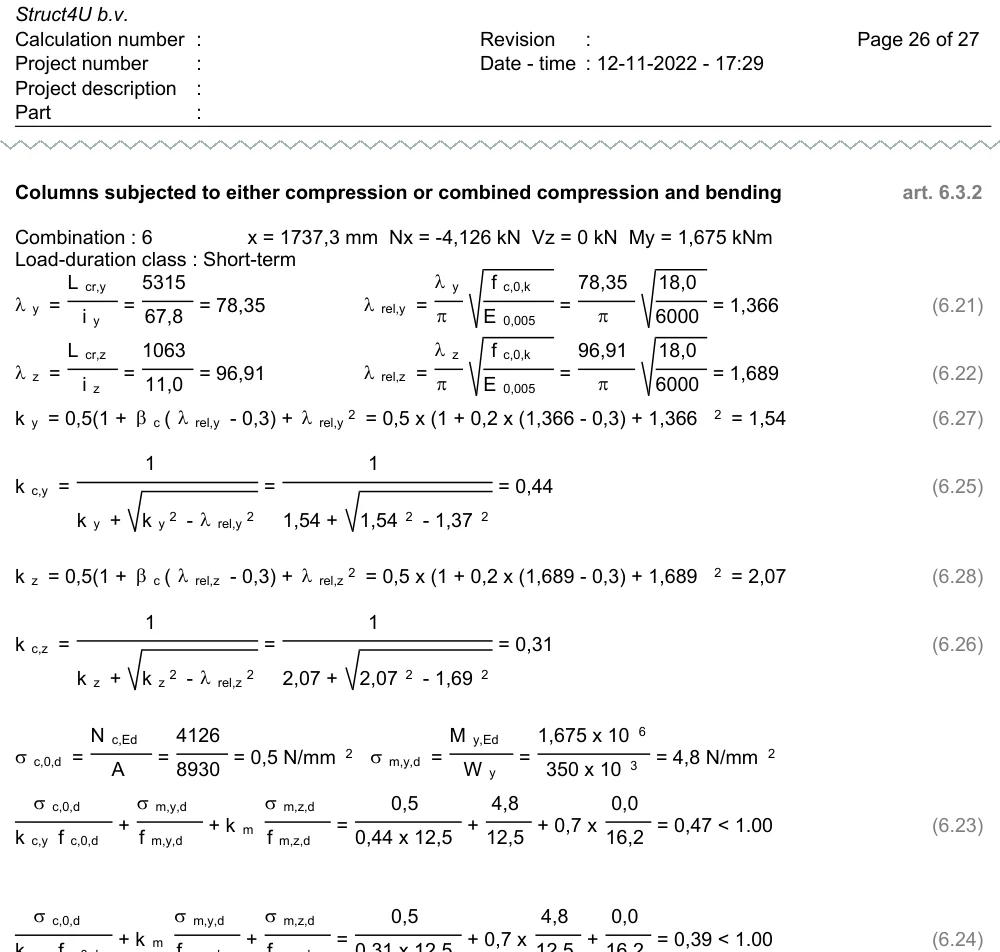
- ClauseArt. 6.3.2: columns in compression, or in compression and bending.
- Formula with the valuesλrel,y from Lcr,y, iy, fc,0,k and E0,05.
- Equation number(6.21) to (6.28), as numbered in EN 1995-1-1.
- Unity check0.47 < 1.00, for load combination 6.
Reports as RTF, PDF or DOCX, in the language set in the program: English, Dutch, German, Spanish, Italian, Norwegian and Portuguese. The output selection decides what goes in.
Source: the XFrame2D manual (References › Limitations; Calculation settings).
Where XFrame2D stops
Stated plainly, so you can decide before you start.
- Frames in one plane. For 3D behaviour, use XFEM4U.
- Node joints are linear springs; a non-linear (trilinear) joint model is not available.
- The global tilt imperfection works in two directions only; member imperfections are handled in the check.
- Windows 10 and 11 only (64-bit). The installer is 234 MB (22 August 2026).
| Item | Maximum |
|---|---|
| Highest node number | 1,000 |
| Highest beam number | 2,000 |
| Profiles | 100 |
| Connections | 100 |
| Load cases | 250 |
| Load cases per combination | 15 |
| Load combinations | 250 |
Works with
The other Struct4U programs, your Word report and the software around you.
Struct4U
- XFEM4UExchange models through XML.
- XBeam2DSingle beams from the frame, in steel, concrete or timber.
- XConstructConnections, column bases, sections and details.
- XSpreadsheetsParametric models from Excel that open in the program.
- Word add-inThe report in your own Word document, kept up to date.
Other software
- XMLImport and export, also to and from XFEM4U.
- Excel DirectCommandsDrive the program from a spreadsheet.
- PythonBuild a parametric model from a script.Premium or pay-per-use
Learn it
In the manual
Videos
Release notes
In a user’s words
We also definitely see that you guys are doing a good job regarding feedback from users. Indeed, we notice that most things are already added the next update!
Recent releases
Fire resistance of steel structures.
A new solver: much shorter calculation times, above all on large models.
Output as a Word document (.docx), with the formulas as Word equations.
Current version 2027.7, released 20 August 2026. All changes are in the release notes. (opens in a new tab)
Questions
01How big can a model be?
Up to node number 1,000 and beam number 2,000, with 250 load cases and 250 combinations. For bigger or 3D structures, use XFEM4U.
02Is the analysis second-order?
Yes. With the Eurocode checks on, the analysis is always geometrically non-linear, with a global imperfection.
03Which materials does it check?
Steel to EN 1993, with the joints to EN 1993-1-8, and timber to EN 1995. For a reinforced concrete beam, section or column, XBeam2D and XConstruct write out the full EN 1992 design.
04Does it generate wind and snow loads?
Yes, for flat, mono-pitch and duo-pitch roofs, with all load combinations, to EN 1991-1-3 and EN 1991-1-4.
05What does XFrame2D cost?
€12 per hour on pay-per-use, billed per minute. Or the Basic 2D licence at €1,770 per year, which also includes XBeam2D, XConstruct and XSpreadsheets.
06Can I exchange models with XFEM4U?
Yes, through XML import and export.
Put your next portal frame in XFrame2D.
Download free and register in the program: you get €100 of pay-per-use credit as a welcome gift.