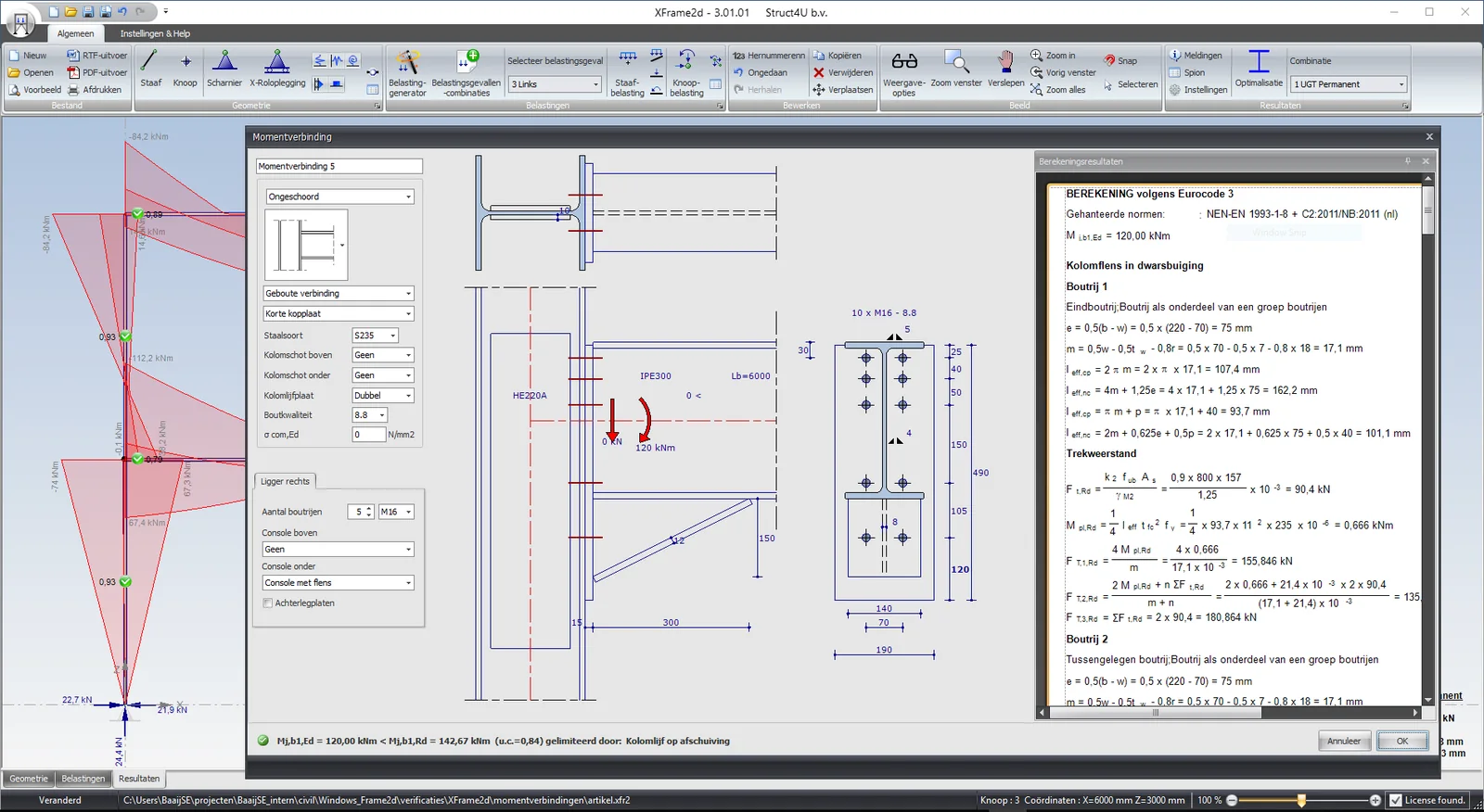
A new release (version 3.01) of our 2D frame program XFrame2d is available.
The most important change:
Beam-to-column moment connections according to NEN-EN 1993-1-8 + c2 fully integrated in XFrame2d
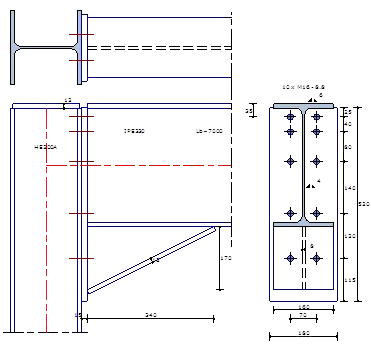
The rotational stiffness influences the force distribution
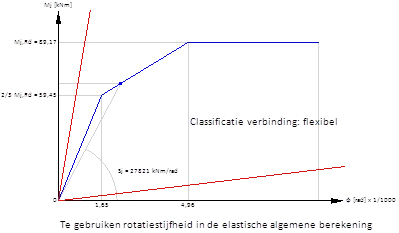
By default, XFrame2d determines a geometrically non-linear force distribution (GNL). The force distribution is determined iteratively. New in this version of XFrame2d is that the beam-to-column moment connections can be entered directly and that the rotational stiffnesses of all connections are determined in each iteration step. Based on the moment occurring in the member connection, the rotational stiffness diagram of the designed connection (see the figure below) is used to determine a rotational stiffness, or spring stiffness, which is then used in the next iteration step. The iteration stops when no more changes occur in the force distribution.
XFrame2d therefore takes a load-dependent rotational stiffness into account for all moment connections. This of course gives the most accurate result and leads to an economically optimal design.
For small moments (below 2/3 Mj,Rd) the initial rotational stiffness Sj,ini is used. For larger moments the rotational stiffness Sj that corresponds to the bending moment Mj,Ed is used. The trilinear rotational stiffness diagram is applied here. See the diagram below.
The steel structure can now be a lot cheaper
By already taking a flexible connection into account in the design of the main load-bearing structure, instead of a fully rigid connection, the connection can become much cheaper and a correct force distribution is calculated. With XFrame2d the lead structural engineer quickly and easily makes an economical design of the main load-bearing structure, including the beam-to-column moment connections. This also saves the costs of a detailing engineer.
See the release notes for an overview of all changes.