Download free

Verification

Check a Struct4U calculation yourself.

The report is written to be rechecked. Each check names its clause, prints its inputs and the formula with the values filled in, and ends with the result against its limit. Here is what to look for, how to recheck a number, and what changed between versions.

Sample reportsChangelogReviewer dossier

1Checkable

Formulas and values are printed in the report itself, not in a separate log.

What makes a report checkable. Five things on every page.

Below is one page of a real report, line for line. The other sample reports print their checks the same way.

XConstruct 2023.1.01 · Column base jointsp. 2 of 4

CALCULATION according to Eurocode

Applied standards:NEN-EN 1992-1-1+C1:2011/NB:2016+A1:2020 nl
NEN-EN 1993-1-1+C2+A1/NB:2016 nl
NEN-EN 1993-1-8 + C2:2011/NB:2011 (nl)
CEN/TS 1992-4-1 · CEN/TS 1992-4-2
1Code, edition and annexThe standards the calculation applies, with edition and national annex.

Compressive strength concrete

Ac0= b1 d1 = 106,2 x 380 = 40374 mm²
Ac1= b2 d2 = 318,7 x 680 = 216747 mm²
kd= √(Ac1 / Ac0) = √(216747 / 40374) = 2,32
C25/30fcd = αcc fck / γc = 1,0 x 25 / 1,5 = 16,67 N/mm²EN 1992-1-1 (3.15)
2Inputs with their sourceMaterial class, factors and dimensions, with values and units.
FRdu= Ac0 fcd kd = 40374 x 16,67 x 2,32 x 10⁻³ = 1559,1 kNEN 1992-1-1 (6.63)
fjd= βj FRdu / Ac0EN 1993-1-8 (6.6)
3The formula, as in the codeIn symbols first, with the clause or equation number beside it.
= 2/3 x 1559,1 x 10³ / 40374 = 25,74 N/mm²
4The values filled inThe same formula with numbers, so you can re-key it.

Condition grout:

tg≤ 0,2 min[bp ; dp] = 0,2 x min[380 ; 460] = 76 mm → OKEN 1993-1-8; 6.2.5(7)
5The check and its verdictCondition, limit and outcome, with the clause.
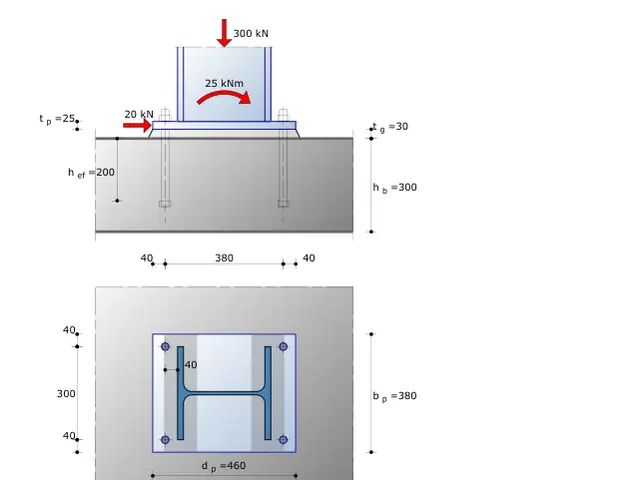
FIG. 1Page 2 of the column base sample report (XConstruct 2023.1.01, 12 Nov 2022), transcribed with the decimal commas and "x" as printed. Open the PDF
“The final output is very complete and gives full printouts of all formulas.”
A user on the output Ing. Ruud van der Breggen, Bouwadvies Van der Breggen B.V.
2Recheck

How to recheck a result

You need the report, your copy of the code and a calculator.

  1. 2.1

    Note the program and version

    The header of every page prints them with the date and time. Cite them in your calculation package.

  2. 2.2

    Find the governing check

    Summary tables list the unity checks per member, load combination and clause. Start with the highest.

  3. 2.3

    Look up the clause

    Each check names its clause or equation number, in the code edition listed under Applied standards.

  4. 2.4

    Re-key the numbers

    Take the line with the values filled in and recompute it. A difference in the last digit is rounding.

  5. 2.5

    Tell us when it differs

    Send the model, the check and the value you expect, with the reason. How to do that is at the end of this page.

FIG. 1, re-keyed2 ÷ 3 × 1559.1 × 1000 ÷ 40374 = 25.74 N/mm²
3Sample reports

Try it on a real report.

Real reports in English and Dutch. Each opens as a PDF.

All sample reports

4Changes

Taken from the release notes of each program.

Calculation changes are flagged.

Each release in the changelog carries a Δ where the release notes describe a correction or method change that can alter results for an unchanged model. The most recent ones:

  • XFrame2D 2027-05-0125 Jul 2026
    • Beams on an elastic foundation and tension-only or compression-only members are now solved iteratively in the load combinations only, as in XFEM4U. Iterating in single load cases could fail to converge.
    • The SLS combinations were not generated correctly. Fixed.
    • The automatic renumbering of nodes, on by default, could remove beams by mistake. Fixed.
  • XFEM4U 2027-04-0110 Jul 2026
    • Plates: where a node falls on a plate edge, the edge is now also split for plates that are hidden (layer switched off).
    • Orthotropic plates: an E entered by the user was overwritten with the default value. Fixed.
    • Correction factor kc (EN 1993-1-1, 6.3.2.3, Table 6.6) now follows Serna et al., using Mmax and the moments at five points.
    • Lateral-torsional buckling: the factor C2 was not calculated correctly in all situations. Corrected; the notes expect a small effect.
  • XBeam2D 2027-03-027 Jul 2026
    • Chessboard loading: the ψ factor in the SLS combinations was wrongly set to 1.00. Fixed.

Full changelog

5Limits

Where the software stops

Knowing the limits is part of checking. These come from the manuals and the release notes.

  • XFEM4U analyses frames second-order (geometrically non-linear). Plates and walls are analysed first-order only.
  • Member imperfections are not modelled: after a second-order analysis with global imperfections, members are checked to EN 1993-1-1, 6.3, with the buckling length equal to the member length (5.2.2(7)b).
  • XBeam2D is geometrically linear. It does not calculate concrete deflections for beams on an elastic foundation or on springs.
  • XConstruct uses the Dutch national annex only.
  • XFrame2D and XBeam2D take up to 1,000 nodes, 2,000 members, 250 load cases and 250 combinations, with 15 load cases per combination.
  • The programs run on 64-bit Windows 10 and 11 only. The Word add-in needs Word for Windows (desktop).

Design codes and annexes per program

6Reviewers

For building control and checking engineers

The reviewer dossier puts the version history, the methods and analysis types, the clauses and annexes covered and the known limits on one page you can print or save as PDF.

Reviewer dossier
7Report a problem

Found a result you cannot reproduce?

Send it to support. Include:

  • the model file (.xfem, .xfr2, .xbe2 or .xcst);
  • the program and version from the report header;
  • the check, page and load combination;
  • the value you expect, with the clause, table or hand calculation behind it;
  • the value in the report.

E-mail support: support@struct4u.com

Recheck it on your own model.

Download the programs for free and run a calculation you know the answer to.

Free download · first hour free · €100 welcome credit when you register · then pay per use · no credit card · Windows